

From pilot to policy: HEMA's nature journey with Spirefly
HEMA is a hundred years old, runs more than 700 stores, and sells almost everything a household needs: food, fashion, cosmetics, electronics. With SBTi targets committed, a solid set of sustainability KPIs, and sustainability linked loans in place, HEMA has turned ambition into accountability. Their 2025 sustainability report is the first to publish a nature assessment across the entire assortment. Five nature impact and risk categories, scored across 40,000 products, aligned with the Science Based Targets Network (SBTN) and the Taskforce on Nature Related Financial Disclosures (TNFD). Spirefly is the platform behind it. For HEMA's Head of Sustainability, Marieke Doolaard, sustainability is not a side project. This is the story of how HEMA went from a first nature pilot to a public policy backed by data, and how Spirefly helped make that possible.

products scored for nature impact & risk
of HEMA's water footprint traced to cotton
target per assessment, down from 4 weeks
public sustainability commitments
Chapter 1. Data
Towards a consolidated picture across food, fashion, cosmetics, and hardware
HEMA’s products range from a baby romper to a bag of coffee, and from a sausage to a pot of paint. Each product contains its own set of materials, sourced from all over the world, each with a unique footprint on nature. The data behind those supply chains lives in ERP systems, spreadsheets, different formats, with different gaps. For a limited sustainability team, it was a monumental task to get that full assortment in view.
The way HEMA managed to get past this roadblock was not by waiting for perfect data. It was by working with data they had, using assumptions and estimations, and getting better every cycle. The first pilot in 2022 with Spirefly just covered a subset of fashion items. 2023 already covered the entire food and fashion ranges, but without any primary data. By 2025, the assessment covered every category, including hardware for the first time. Food ingredients now come with country of origin and weights. Fashion comes with material composition. The same dataset now feeds both the nature assessment and the carbon footprint, so the two can finally be read together.
Spirefly’s data model is flexible and intelligent: behind the scenes, Spirefly cleans the data, models missing countries of origin, uses LCA databases, and performs geospatial analysis. Where supplier data stops, Spirefly takes over. The result is one consolidated picture that can inform decisions today, while further data improvements are on their way.
What used to take four weeks of data work in 2023 took four days in 2025. The target for the next assessment is four hours. That time saving is not the point in itself. The point is what it frees up: more hours to drive change across the business.
Chapter 2. Insights
Cotton, coffee, cacao: the signal across 40,000 products
Once the data is in, the question every retailer faces is: across tens of thousands of products, what actually matters? And how do the different nature topics across water, land, and biodiversity, actually relate to the different parts of my business?
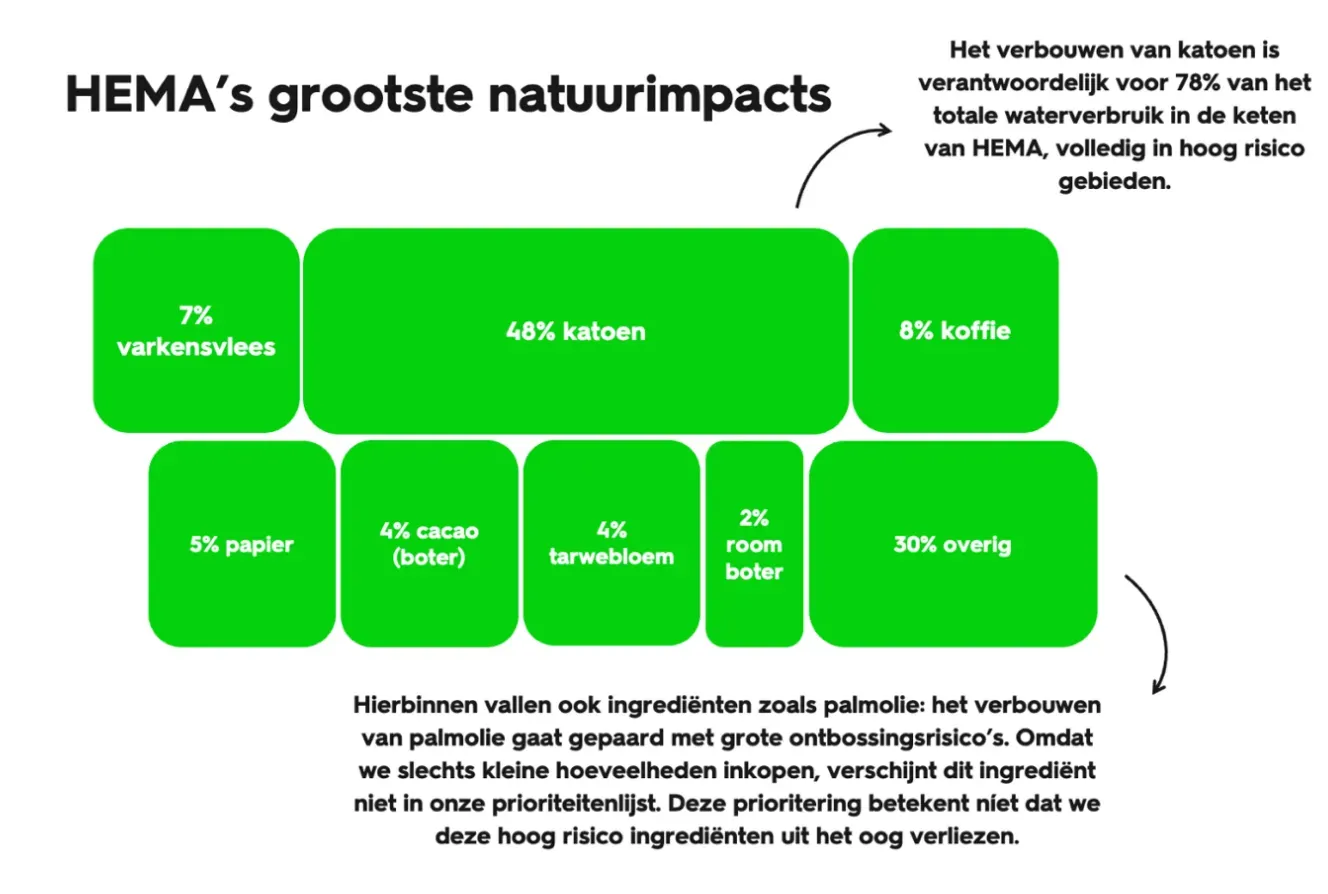
Spirefly helped HEMA to look at this through two lenses. The impact side: land use, soil pollution, water use, water pollution. And the risk side: deforestation zones, water scarce regions, degraded soils, and polluted land and water. Together they show where HEMA impacts but also depends on vulnerable ecosystems and how that translates to business risk and priorities.
The clearest finding was that cotton alone accounts for 78% of HEMA’s total water footprint, and a large share is grown in regions where water is already scarce. Zoom in further and the picture gets more specific: cotton rompers, just 1.3% of total purchase weight, drive 3% of the water footprint and 2.3% of total nature impact. Coffee and cacao together account for roughly 15% of land use, both with high deforestation risk in their growing regions. Pork connects to soil pressure through manure and the soy and maize feed chains behind it. Each hotspot has a different lever, and each lever requires a different conversation.
This is where Spirefly’s AI workbench changes the shape of the work. The findings are not handed over as a report. They live inside an environment where the sustainability team can interrogate them directly in the context of a specific task. They can make manuals for the different buying teams, run through scenarios for different material strategies, design KPI’s, and prepare their sustainability report.
Spirefly understands my business, my data and the frameworks. I can do a quantitative water assessment, put the results in context of our business, and explore relevant actions in one go.
That move, from a finding to a why and then to a possible solution, is what carries the work into the rest of the organisation. Because a clear story is what bridges the gap between complex data and company-wide adoption.
Chapter 3. Taking action
Five public commitments and a way to measure progress
HEMA consolidated the entire hotspot analysis across carbon ánd nature into five concrete commitments:
- Preferred Materials & Ingredients: Transition to low-impact alternatives, including recycled, regenerative, or organic cotton, FSC-certified wood, certified food ingredients, and an increased share of recycled plastics.
- Wastewater Management: Ensure textile factories with wet processes meet clean wastewater standards by 2028 (Tier 1) and 2030 (full supply chain).
- Supplier Efficiency: Execute action plans with high-priority suppliers to improve operational efficiency and transition to renewable energy.
- Enhanced Due Diligence: Mitigate risks in high-impact areas through focused sourcing (e.g., Tony’s Open Chain for cacao) and increased site visits by CSR teams in priority production facilities.
- Commodity Traceability: Improve traceability for deforestation-risk commodities and Spirefly-prioritized items (including EUDR compliance), while increasing transparency on resource usage through BEPI self-assessments.
These commitments directly target the hotspots identified in Spirefly, and therefore make sure that HEMA’s actions contribute effectively to halting biodiversity loss. Certifications are an important lever, but transparency is seen as another true catalyst for change. However, you always need to balance impact with influence: even when raw material extraction poses higher risks, HEMA is more directly engaged with factories, so their leverage there allows them to drive the most tangible improvements.
HEMA now has a nature baseline and can start measuring progress, year on year. Between cycles, the team works in Spirefly on translating their data into policies, data improvement, and product redesign. With predictive scenario modeling, HEMA makes data-backed adjustments long before the next audit. Together, we are on a mission to turn reporting from a stressful obligation into a moment of celebrating progress.
The work is not done. 2030 is still some way out, but the targets are real, and the reduction pathway is steep. But the journey from pilot to policy is now behind them. And the cycle that follows, measuring, deciding, committing, and measuring again, is exactly the part Spirefly was built for.
“Spirefly helps us to make our ambitions actionable.”
More case studies
Picnic: Scalable Nature Intelligence for Retail
Picnic is a leading online grocer, managing a massive catalog of 15,000 products. Sustainability at Picnic is driven by a lean ESG team consisting of Anna Krotova and Jorrit Vervoordeldonk. While the team is highly experienced in sustainability, they were still lacking quantitative nature and biodiversity insights as the basis of their nature strategy.

Westland Kaas: Building a Sustainability Business Case in Food
Westland Kaas is a Dutch, family-owned cheese company aiming for 100% net climate neutrality by 2036. Westland has a brand-driven focus, and a partially outsourced supply chain. This makes it important to engage with suppliers to reduce supply chain emissions. Daan Mes spearheads all sustainability initiatives across the organization and its value chain.

Norsys: Giving Nature a Science-Based Voice in IT Services
Norsys, a leading French Digital Services Group, pioneered "Nature Governance" by granting Nature a voting seat on its Board of Directors. This initiative, led by Thomas Breuzard (Permaenterprise Director) and Julien Gautier (Project Officer), aims to ensure that environmental impact is a primary consideration in every corporate decision.
Ready to turn your supply-chain data into a nature strategy?
Discover how Spirefly can boost your sustainability ambitions and save valuable time and costs.