
Planetary boundaries unpacked: biogeochemical flows and why nitrogen Is starting to become a business risk
Pieter van Exter · 13 May 2026
Humanity has nearly tripled the "safe" nitrogen boundary, creating a systemic leak where excess fertilizer destroys soil biodiversity and triggers massive oceanic dead zones.
Nitrogen: The land is getting too much of a good thing
Nitrogen is in our DNA, our proteins, every leaf on every tree. In agriculture, it is the difference between a harvest and a famine. Without synthetic nitrogen fertilizers, roughly half of the world’s population would face starvation within a few harvest cycles (Erisman et al., 2008). But apply too much, and the same nutrient becomes a diffuse pollutant that damages ecosystems faster than they can recover. We crossed the safe limit for nitrogen flows (the biogeochemical flows planetary boundary) back in 1970 and are now running at nearly triple it. We usually only notice the end of the line: green rivers, dead fish. But the problem starts much earlier, in the soil. If you work in sustainability, this is already part of your system, whether you have been tracking it or not.
What is terrestrial eutrophication, and why does it matter?
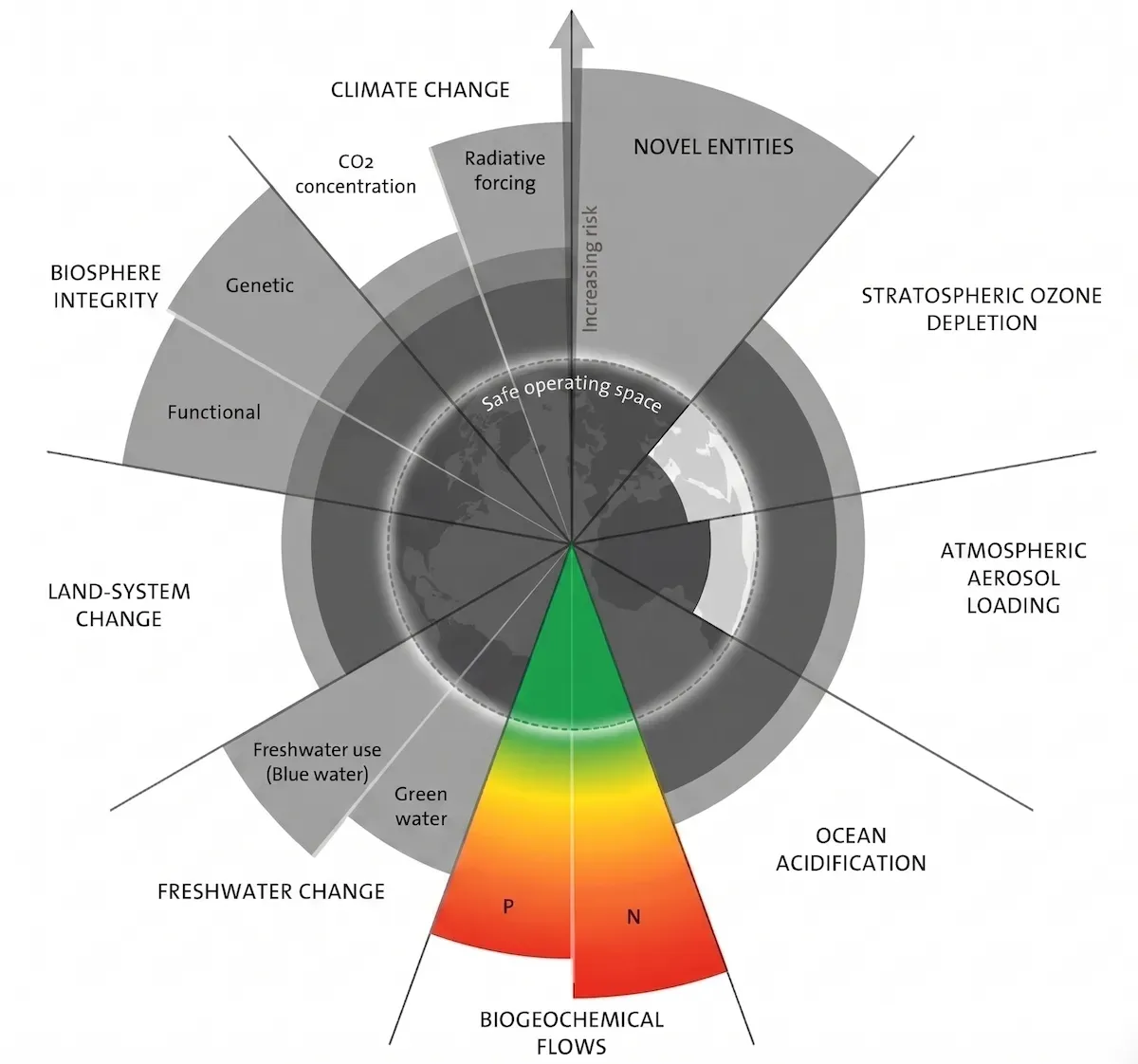
Adapted from: Azote for Stockholm Resilience Centre, based on analysis in Sakschewski and Caesar et al. 2025.
Terrestrial eutrophication is the over-enrichment of land ecosystems with nitrogen, caused by fertilizer runoff, livestock waste, and atmospheric deposition from fossil fuel combustion. When nitrogen inputs exceed what plants can absorb, fast-growing species crowd out specialists like wildflowers and lichens, degrading biodiversity and ecosystem function. It is distinct from aquatic eutrophication but typically precedes it: saturated soil releases excess nitrogen into waterways, driving the algal blooms and dead zones more commonly associated with the term.
This falls under the Biogeochemical Flows planetary boundary, which tracks how nitrogen and phosphorus move around the Earth. On the surface, nitrogen-saturated land looks fine. Everything is green. But underneath, a slow-motion monoculture is taking hold. A few aggressive, nitrogen-hungry species crowd out the specialists. The wildflowers, the legumes, the lichens simply cannot compete. They disappear, and the ecosystem becomes a hollow version of itself. (US Forest Service / ESA, 2017)

There is actually a way to see this with your own eyes. Stinging nettles (Urtica dioica) are nitrogen specialists. They thrive where nitrogen levels are high and outcompete almost everything else when they are. If you walk the edge of a field or along a drainage ditch and find dense patches of nettles, that is not coincidence. It is a signal that nitrogen has been accumulating there, probably for years. Ecologists use them as an indicator species for this reason. The plant that most of us learned to avoid as children turns out to be one of the more honest reporters we have on soil health.
The nitrogen-water bridge: one crisis, two habitats
You cannot talk about soil nitrogen without talking about water pollution. They are two ends of the same pipe. When soil becomes saturated with nitrogen, it cannot hold any more. The excess washes away with rain or irrigation, setting off a two-stage collapse:
Stage 1 — The land: Soil eutrophication kills off local biodiversity and turns grasslands into carbon-leaking monocultures.
Stage 2 — The water: That leaked nitrogen enters groundwater and rivers. By the time it reaches the coast, it is fueling algal blooms that suck the oxygen out of the water and create dead zones in the ocean.
The nitrogen problem is growing
This nitrogen arrives two ways. Some of it falls from the sky. When we burn fossil fuels, reactive nitrogen enters the atmosphere and eventually settles on meadows and forests that have never been farmed, altering ecosystems that were never part of anyone’s agricultural plan. The rest is applied by hand, through a process that begins with the Haber-Bosch synthesis of ammonia and ends with industrial-scale fertilizer application across billions of hectares of cropland.
Global use of nitrogen fertilizer climbed 34% in just two decades. (FAO, 2024) We need it. About half the world is fed by food grown with synthetic fertilizers. (Our World in Data) But crops cannot absorb it all. Each year, roughly 200 million tonnes of reactive nitrogen escape into the environment.
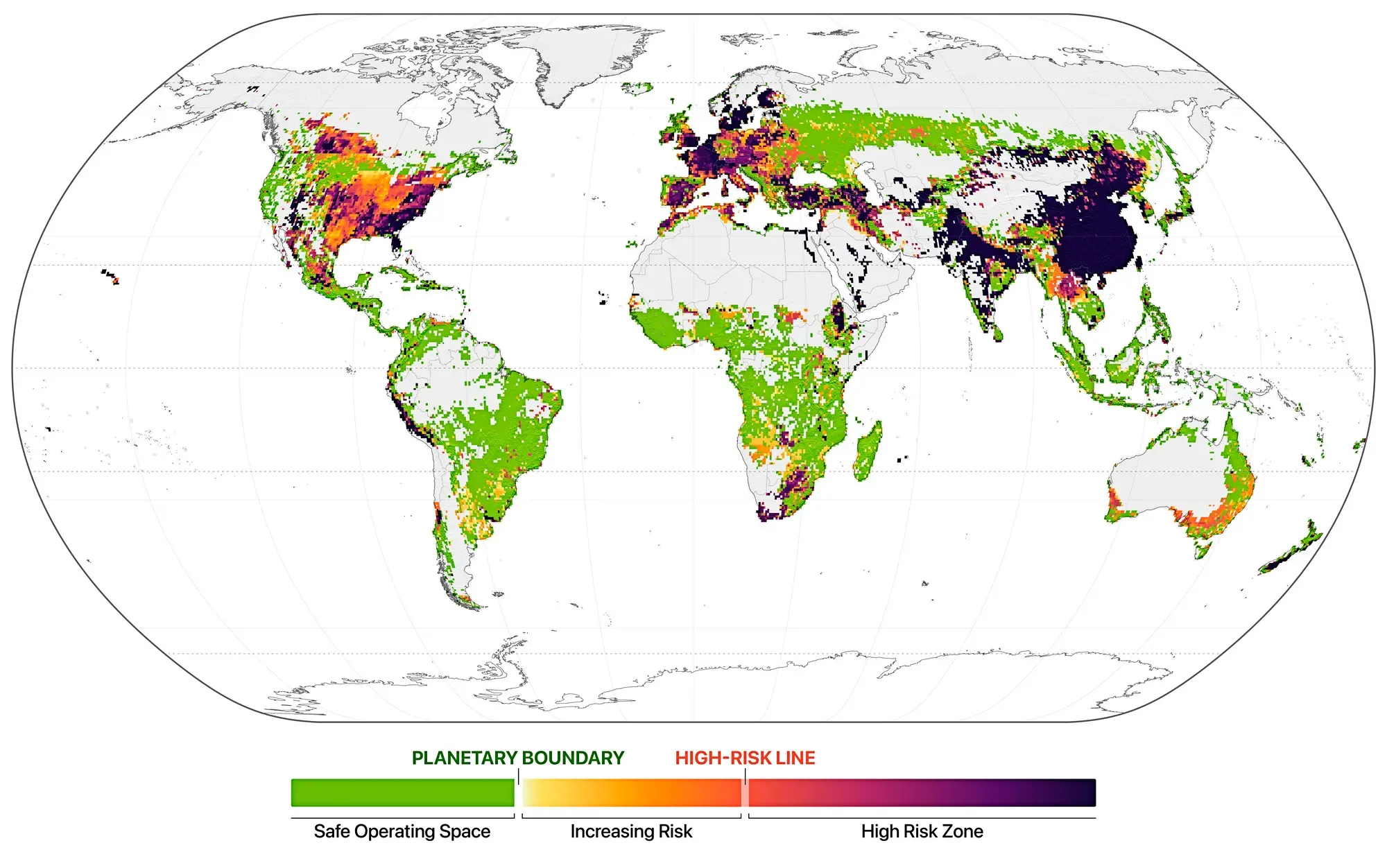
Source: Schulte-Uebbing, L.F., Beusen, A.H.W., Bouwman, A.F. et al. From planetary to regional boundaries for agricultural nitrogen pollution. Nature 610, 507–512 (2022). https://doi.org/10.1038/s41586-022-05158-2
The nitrogen boundary in numbers
- The 1970 breach. We crossed the safe limit for nitrogen flows back in 1970. Today we are running at nearly triple that limit. (Planetary Health Check 2025)
- The trillion-dollar waste. Nitrogen pollution costs the global economy between $340 billion and $3.4 trillion every year, covering damage to human health, lost ecosystem services, and the direct cost of fertilizer that never reached a crop. (UNEP Frontiers)
- The warming multiplier. Nitrous oxide (N₂O), the greenhouse gas released from nitrogen-saturated agricultural soils, is 273 times more potent than CO₂. (IPCC AR6)
- The acceleration. The atmospheric accumulation rate of nitrous oxide recently jumped by 30%, meaning we are outrunning our worst-case models. (Global Nitrous Oxide Budget 2024)
Nitrogen risk for business: regulation, yields, and N₂O liability
Frameworks like the TNFD and SBTN are moving nature-positive from a voluntary commitment toward a reporting expectation. CSRD’s ESRS E2 (Pollution) and E4 (Biodiversity) standards already require companies to assess and disclose pollution-related impacts on ecosystems. Nitrogen is one of the primary pressures being measured. The EU Nature Restoration Law goes further, requiring member states to restore degraded ecosystems, many of which are degraded specifically because of nitrogen loading. For food and agriculture companies, this creates regulatory exposure they are not yet pricing in.
There is a direct human health dimension too. Ammonia emissions from farms combine with vehicle exhaust to form fine particulate matter. Nitrate leaching contaminates drinking water. Dutch water authorities have already issued restrictions and fines to farms in nitrogen-sensitive zones.
Then there is the soil itself. Nitrogen-saturated soil is not productive soil. Over time it loses its ability to cycle nutrients and retain water, making crops more sensitive to drought and flooding. If your business depends on stable commodity prices, a degraded soil base is already creating price exposure in supply chains you may not have mapped yet.
What can actually be done
The core idea is shifting from a pollution model to a nitrogen circular economy: recovering and reusing nitrogen rather than letting it escape. This is the goal of the Colombo Declaration on Sustainable Nitrogen Management, which aims to halve global nitrogen waste by 2030. (UNEP / Colombo Declaration)
The 4R framework (Right source, Right rate, Right time, Right place) is where most agricultural supply chain work starts. Precision agriculture using GPS-guided, variable-rate application has reduced nitrogen use by 20–30% in practice while maintaining or improving crop yields. (4R Stewardship / TFI) That is a meaningful reduction, not a rounding error.
Cover crops and diverse rotations take a different approach: they act as scavengers, catching excess nitrogen before it leaches into groundwater. Research shows non-legume cover crops reduce nitrate leaching by an average of 56%, with reductions above 70% in high-risk zones. (Journal of Environmental Quality)

Clovers are excellent cover crops.
On the measurement side, companies are increasingly tracking Nitrogen Use Efficiency (NUE) as a supply chain KPI. The EU Nitrogen Expert Panel has developed a standardized NUE indicator that makes nitrogen waste visible and auditable across agricultural value chains, which is useful both for internal management and for the disclosure requirements coming down the pipeline.
The things we usually miss
Nitrogen and carbon are a coupled system. The nitrogen and carbon cycles are physically connected: nitrogen availability controls how much CO₂ land can absorb. Knock the nitrogen cycle out of balance and you reduce the Earth’s ability to buffer its own emissions. This is why you cannot manage carbon in isolation from the other planetary boundaries. (Gruber & Galloway, 2008)
Phosphorus runs parallel. The Biogeochemical Flows boundary covers both nitrogen and phosphorus. Nitrogen tends to drive terrestrial degradation; phosphorus is the primary trigger for freshwater algal blooms. They often amplify each other.
The safe limits are not where we assumed. Studies have documented plant die-off at nitrogen levels below current legal thresholds, which means the regulatory floor is probably in the wrong place. And nitrogen persists. Legacy deposits from decades of over-application will keep leaching into water systems long after application rates are brought under control.
The takeaway
If your company sources from biobased products, you are already exposed to nitrogen risk: supply chain, regulatory trajectory, and climate targets given the nitrous oxide multiplier. Most sustainability managers are not tracking it. That gap is going to become visible as TNFD reporting lands and CSRD nature requirements become operational. Better to find it yourself first.
Frequently asked questions
What is the biogeochemical flows planetary boundary?
The biogeochemical flows planetary boundary tracks how much nitrogen and phosphorus humanity releases into the environment each year. Both elements are essential for life, but when introduced at industrial scale through fertilizers, livestock waste, and fossil fuel combustion, they overwhelm the natural cycles that ecosystems depend on. The nitrogen boundary was crossed in 1970; we are currently at nearly triple the safe limit.
How does nitrogen pollution affect business?
Three main pathways. Regulatory exposure: CSRD, TNFD, and the EU Nature Restoration Law are increasingly measuring nitrogen-related impacts as part of nature disclosure, and the standards are tightening. Supply chain instability: over-fertilized soils degrade over time, becoming less water-retentive and more vulnerable to weather extremes, which feeds into commodity price volatility. Climate liability: nitrous oxide released by nitrogen-saturated soils is 273 times more potent than CO₂, a hidden variable in most corporate climate targets that is not yet being managed.
What is nitrogen use efficiency (NUE)?
NUE measures how much of the nitrogen applied to agricultural land is actually taken up by crops, versus lost to the environment. Most agricultural systems are surprisingly inefficient. A significant portion of applied fertilizer escapes before plants can use it. The EU Nitrogen Expert Panel has developed a standardized NUE indicator that companies can use to track and reduce nitrogen waste across their supply chains.
How does nitrogen relate to climate change?
Two ways. First, nitrogen-saturated soils emit nitrous oxide (N₂O), which is 273 times more potent than CO₂ as a greenhouse gas, making agricultural nitrogen one of the largest non-CO₂ sources of warming. Second, and less discussed: nitrogen availability determines how much CO₂ terrestrial ecosystems can absorb. Disrupt the nitrogen cycle and you shrink the planet’s natural carbon sink. The two problems share the same soil.
Sources: UNEP Frontiers Report on the nitrogen cycle · Colombo Declaration (UNEP) · 4R Nutrient Stewardship Framework (TFI) · EU Nitrogen Expert Panel NUE Indicator · Clark et al. 2017 (nitrogen-induced terrestrial eutrophication) · Cover Crops & Nitrate Leaching, J. Environ. Qual. 2018 · Gruber & Galloway 2008, Nature Geoscience · Planetary Boundaries 2025, Globaia



Want to see how Spirefly works?
Book a demo for a walkthrough of the product.